Introduction
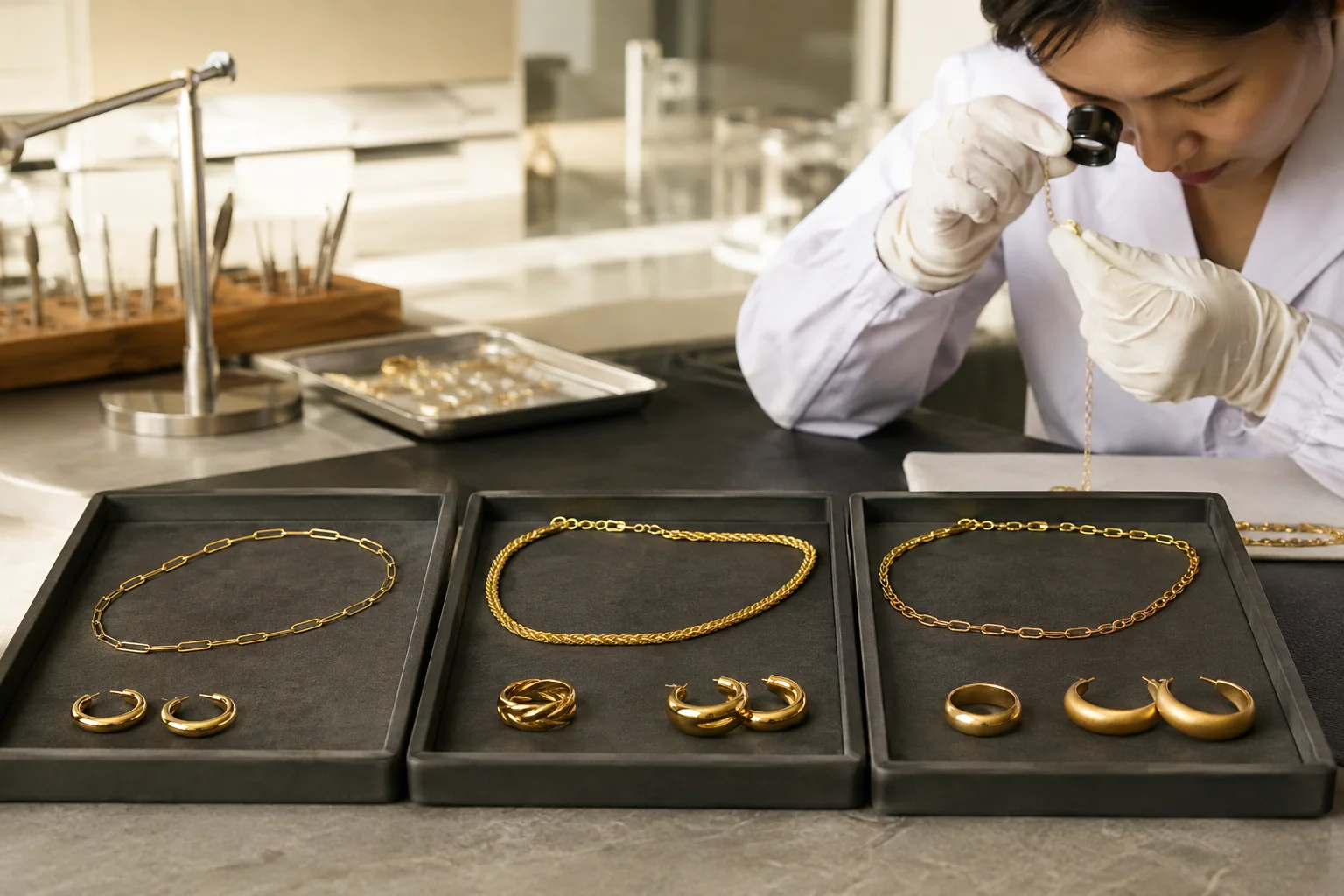
Gold vermeil, conventional gold plating, and PVD-coated stainless steel can all produce a warm gold appearance. They are not, however, the same product category. The base metal, coating process, finish specification, intended wear, retail price, and wording used at point of sale all change the buying decision.
Retail buyers often start with a visual brief: “We want a rich 18K gold look.” That is a useful direction, but it does not answer the manufacturing questions. What is the base metal? Which parts touch skin? Is the product intended for occasional gifting or frequent wear? Is a thickness target required? Is a particular surface treatment part of the brand claim? What documentation does the target market or retail account need?
This guide gives purchasing teams a practical way to compare the three options before requesting samples. It does not promise a fixed wear life. Wear is affected by construction, friction, perspiration, cosmetics, storage, care, plating or coating specification, and how a piece is used.
The short answer: which material should a buyer choose?
Choose gold vermeil when a sterling-silver base and a controlled precious-metal claim suit a premium demi-fine offer. Choose conventional gold plating when design flexibility and price positioning matter, provided the base metal and finish are fully specified. Choose PVD stainless steel when a steel-based, contemporary assortment and a coating process suited to the product design fit the brand’s positioning. The correct choice is commercial and technical—not simply visual.
1. First, separate the base metal from the gold appearance
The first source of confusion is that buyers compare the color but not the construction. A useful product specification has two layers:
- Substrate: sterling silver, brass, stainless steel, or another defined metal.
- Surface system: a gold coating or plating process, color target, any barrier or protective layer, and the agreed acceptance standard.
This distinction affects weight, cost, finishing behavior, hallmark or product-description rules, recycling story, skin-contact considerations, and repair options. It also changes the questions that should be asked at factory testing and shipment inspection.
For example, “18K gold necklace” should not appear on an RFQ if the intended item is a gold-colored surface finish over another metal. The buyer should instead specify the base metal and the surface application, then validate the consumer-facing description for the market. The U.S. Federal Trade Commission advises jewelry sellers to describe products truthfully and disclose material information; its consumer guidance distinguishes gold-filled products from gold-plated products and identifies vermeil as a particular gold-plated product with a sterling-silver base. See the FTC consumer guide and the FTC’s Jewelry Guides resources.
2. Gold vermeil: a premium route when the claim is controlled
Gold vermeil is generally used for a sterling-silver item with a gold surface application. In the United States, FTC Jewelry Guides have historically described vermeil in terms of a sterling-silver base, gold or gold alloy of at least 10 karats on significant surfaces, and a minimum equivalent fine-gold thickness of 2.5 microns. Retailers should check the current guidance and the rules in each destination market before making a claim.
For a buyer, the important point is not to use the word “vermeil” as a style label. It is a construction and marketing term. A good vermeil specification should define:
- sterling silver grade and any required marking;
- gold color and gold-alloy target where relevant;
- agreed coating thickness or a stated test/report requirement;
- the surfaces included in the finish requirement;
- attachment points, solder areas, and moving components that need extra review;
- any anti-tarnish or protective system; and
- care-card language and customer expectations.
Where vermeil fits commercially
Vermeil is often appropriate for a brand positioned between fashion jewelry and solid-gold fine jewelry. It can support a higher perceived material value than a base-metal item, but it also makes material verification, finish approval, and price discipline more important. It may be less suitable for a very low retail price, an item with intense abrasion points, or a collection that needs many seasonal colors at the lowest cost.
During sample review, inspect the real geometry rather than only the center of a flat pendant. Edges, chain links, jump rings, clasp surfaces, stone settings, and engraved recesses may respond differently during finishing. A sample photograph under strong studio lighting can hide color variation that becomes visible under a retail counter light or daylight. Ask to view the sample under a consistent, agreed viewing condition and retain the sample as the production reference.
3. Conventional gold plating: flexible, but only when the specification is precise
“Gold-plated” tells a buyer that gold has been applied to a base metal. It does not, on its own, reveal the base metal, gold fineness, coating thickness, color tolerance, barrier system, or intended wear. Those omissions make gold-plated jewelry versatile for design and price, but risky when a supplier quote is based on assumptions.
Gold-plated designs can be developed over different base metals, including brass and sterling silver. The buyer must not infer quality from a color name. Ask for the construction in writing and keep each material option on its own line in the quotation. If a cost-down version changes the base metal or finish system, issue a new product code or revision rather than treating it as an informal equivalent.
Gold-plated jewelry buyer checklist
Before approving a sample, confirm:
| Question | Why it matters |
|---|---|
| What is the base metal? | It affects product weight, color, cost, and customer-facing description. |
| What is the agreed finish? | “Gold tone” is not enough; define the target shade and surfaces. |
| Is a thickness target or test requirement part of the order? | It turns a general appearance request into a measurable acceptance point. |
| Are high-wear areas identified? | Clasps, rings, edges, and moving parts may need special review. |
| Is there a sealed approved sample? | It provides a reference during production and inspection. |
| What care guidance will the consumer receive? | It aligns expectation with the product’s intended use. |
Avoid writing an arbitrary wear-life promise into product copy. A statement such as “will never fade” is difficult to support because end-user conditions are uncontrolled. A better approach is to state the actual material construction, explain care, and define what the factory must inspect before release.
4. PVD stainless steel: process, substrate, and product design must work together
PVD stands for physical vapor deposition, a family of vacuum-deposition processes used to create surface coatings. In jewelry sourcing, “PVD stainless steel” usually refers to a stainless-steel item with a gold-colored PVD coating. This is a useful category for a modern, durable-looking fashion jewelry assortment, but it should not be presented as equivalent to gold vermeil or solid gold.
The strength of a PVD program is often its repeatable finish system and suitability for stainless-steel design families. The limitations are just as important: not every complex component, color, surface texture, or repair route behaves identically. Sharp edges, poor pre-treatment, incompatible components, high-friction contact points, and uncontrolled color matching can still create problems.
Ask the manufacturer how the stainless steel is prepared before coating, which components are included in the coating batch, how finish color is approved, and what production checks are used for adhesion or appearance. If the buyer requests testing, agree the method, sample count, pass/fail rule, and report format before production. Do not assume that a general PVD statement proves the performance of a particular design.
Where PVD stainless steel fits commercially
PVD stainless steel can be a strong option for minimal chains, hoop earrings, signet rings, and trend-led collections where a steel base and contemporary finish story fit the target customer. It may also suit product ranges that need consistent color across coordinated pieces. It is not automatically the best choice for every stone setting, delicate filigree, or premium precious-metal narrative.
The product application matters. A chunky bracelet that repeatedly contacts a desk, gym equipment, or other jewelry experiences a different friction profile from an occasional-wear pendant. Build the expected use into the material decision and care messaging.
5. Compare the options by retail job, not only by cost
| Decision factor | Gold vermeil | Gold-plated jewelry | PVD stainless steel |
|---|---|---|---|
| Base metal | Sterling silver in a valid vermeil construction | Must be specified; varies by item | Stainless steel in the standard category description |
| Retail story | Demi-fine / precious-metal-led | Flexible fashion-to-premium positioning | Modern, steel-based fashion positioning |
| What to control | Silver base, gold claim, thickness/finish specification, marking | Base metal, finish system, color, thickness/test requirement | Steel grade where relevant, coating process, color target, component suitability |
| Best sample focus | Coverage, edges, marking, chain and clasp behavior | Exact construction and high-wear points | Surface preparation, coating uniformity, moving parts, color match |
| Copy risk | Misusing “vermeil” | Calling a surface color “gold” without qualification | Suggesting it is precious-metal jewelry or making unsupported durability claims |
This table is a planning tool, not a legal classification. Consumer claims and required markings should be reviewed for each market and product configuration.
6. Build a finish approval protocol before bulk production
A finish approval protocol reduces subjective disputes. It should include a sealed or signed sample, the product code and revision, the target viewing condition, photos for orientation, and a short description of acceptable variation. For stone or pearl pieces, add a reference for acceptable natural variation. For a collection with multiple gold tones, approve each finish separately rather than relying on a single generic “gold” sample.
At the factory-testing stage, practical checks can include visual review of surface coverage, component fit, clasp function, stone security, sharp-edge review, finish consistency against the approved reference, and any buyer-specified laboratory or process checks. At shipment inspection, confirm that the packed pieces and labels match the approved material description. If the carton contains two finishes, the item code and carton count must make them traceable.
Do not confuse a report with a universal product guarantee
An SGS report, a REACH-related test, or a factory certificate may be valuable evidence. Its value depends on what sample was tested, what method was used, when it was issued, and whether it represents the materials used in the current lot. For EU-facing products, buyers should begin with the ECHA REACH restriction information and the EU product-safety framework, then determine the required product-specific route.
OWGOW can provide BSCI, ISO, SGS, REACH, and RoHS documentation for buyer review where applicable. The buyer should request documentation early enough to address any material change before mass production.
7. Match care instructions to the actual product
Care copy is not a fallback for weak quality; it is a truthful way to explain a product’s intended use. For surface-finished items, practical guidance may include removing jewelry before swimming, cleaning, fragrance application, heavy exercise, or abrasive contact; storing pieces dry and separately; and using a soft cloth where appropriate. Avoid care language that implies a product is fragile if it was marketed for frequent wear, and avoid frequent-wear promises if the construction does not support them.
Good care instructions also support returns handling. Customer service can compare a claim against the defined use, documented construction, and approved sample rather than debating a vague “quality” expectation.
FAQ
Is gold vermeil better than gold-plated jewelry?
Not automatically. Vermeil is a specific sterling-silver and gold-surface construction that may suit a premium product story. Conventional gold plating can be the better commercial choice when its base metal, finish, expected use, and consumer copy are controlled. Choose based on the product and retail position.
Is PVD stainless steel the same as gold vermeil?
No. PVD stainless steel normally describes a gold-colored PVD coating on a steel base. Vermeil is a gold-plated product with a sterling-silver base. They have different material narratives, manufacturing controls, and consumer descriptions.
How should a buyer specify gold color?
Approve a physical sample, describe the finish as precisely as your factory can reproduce, and state the viewing condition and allowed variation. If a product has multiple finishes, assign each one a separate code and approval reference.
Can a supplier promise that plating will never fade?
That is not a reliable universal promise. Actual wear depends on design, finish system, friction, care, sweat, cosmetics, and use. Ask instead for the agreed construction, sample approval, inspection plan, and accurate care information.
Conclusion
Material selection should make a buyer’s commercial promise easier to keep. Gold vermeil supports a sterling-silver, premium demi-fine story when the term is used correctly. Conventional gold plating creates wide design and cost flexibility when the construction is documented. PVD stainless steel suits a steel-based collection when the product design and coating process are validated together. In every case, the safest path is a written specification, a controlled sample, and a shipment inspection that checks the product against that reference.
CTA: Build a material brief before you sample
Tell OWGOW the product category, target market, expected retail range, preferred metal and finish, estimated quantity, and any documentation request. We will help identify the decisions that need approval before a sample is released. [Send Your Requirements]
---
ARTICLE TAGS
RELATED RESOURCES
Keep building the brief
Use these buyer resources to connect this decision with the next specification, approval, or sourcing step.
- Sustainability & compliance hub →
- Pearl Types for Jewelry Collections: A B2B Buyer’s Sourcing Guide →
- How to Choose a Private Label Jewelry Manufacturer →
External buyer reference: FTC Jewelry Guides