Introduction

A polished product image can make a surface finish look simple, but a consumer-facing description may imply metal content, thickness, durability, care, or performance. The copy therefore needs its own controlled review alongside the sample and product data sheet. This guide is written for jewelry brands, wholesalers, importers, and procurement teams preparing a private-label or repeat wholesale order. It is not a legal, medical, customs, or product-performance opinion. It explains how to turn a buyer question into a documented sourcing decision that can survive quotation, sampling, factory testing where appropriate, shipment inspection, and future reorder planning.
At OWGOW, the planning MOQ is 100 pieces. Sample planning is typically about three days after the design direction and materials are confirmed; standard bulk production is typically around 7–10 days after scope approval. These are planning references, not universal promises: the actual route depends on product complexity, customer requirements, materials, components, artwork, packaging, approvals, and the requested delivery arrangement.
The six search themes this guide answers
This page serves one closely related buyer decision with six distinct search themes, rather than forcing unrelated keywords into one article:
- jewelry plating claims
- gold plated jewelry description
- coated jewelry labeling
- jewelry material disclosure
- jewelry product claim checklist
- private label jewelry copy
Start with the finished SKU, not a category label
Build one source record for the product name, base material, finish description, supporting documentation, approved wording, image revision, care language, and destination. Compare the record with the actual sample before release. The buyer should create one working record before requesting a final quotation. It should include the SKU or working code, the product image or drawing, material and finish direction, dimensions, components, estimated quantity, packaging route, target market, and the decision owner. If a field is not known, mark it as pending instead of allowing it to become a hidden supplier assumption.
This is especially important in fashion jewelry because near-identical items can be commercially different. A small change in a chain, closure, decorative component, size, surface, logo location, display card, or pouch can affect price, product description, pack-out, inspection, and retailer expectations. The buyer does not need a long document at the first conversation, but the record should become more specific as the order advances.
| Decision area | What to define | Evidence before bulk release |
|---|---|---|
| Product identity | jewelry plating claims, SKU, current revision, and visual reference | Approved sample or controlled image set |
| Physical configuration | Material, finish, components, dimensions, and product application | Written specification tied to the sample |
| Commercial scope | Quantity, packaging, target market, and handover assumptions | Quote and approved change record |
| Quality review | Visible, functional, packing, and shipment inspection points | Buyer-defined acceptance checklist |
Compare options against the intended product application
A polished product image can make a surface finish look simple, but a consumer-facing description may imply metal content, thickness, durability, care, or performance. The copy therefore needs its own controlled review alongside the sample and product data sheet. A credible comparison does not ask only which option is “best.” It asks which construction matches the customer, product role, price position, target market, and evidence available for the final wording. For example, a gift item, an everyday accessory, a statement piece, and a retail display SKU can have different priorities even when they look similar in a photograph.
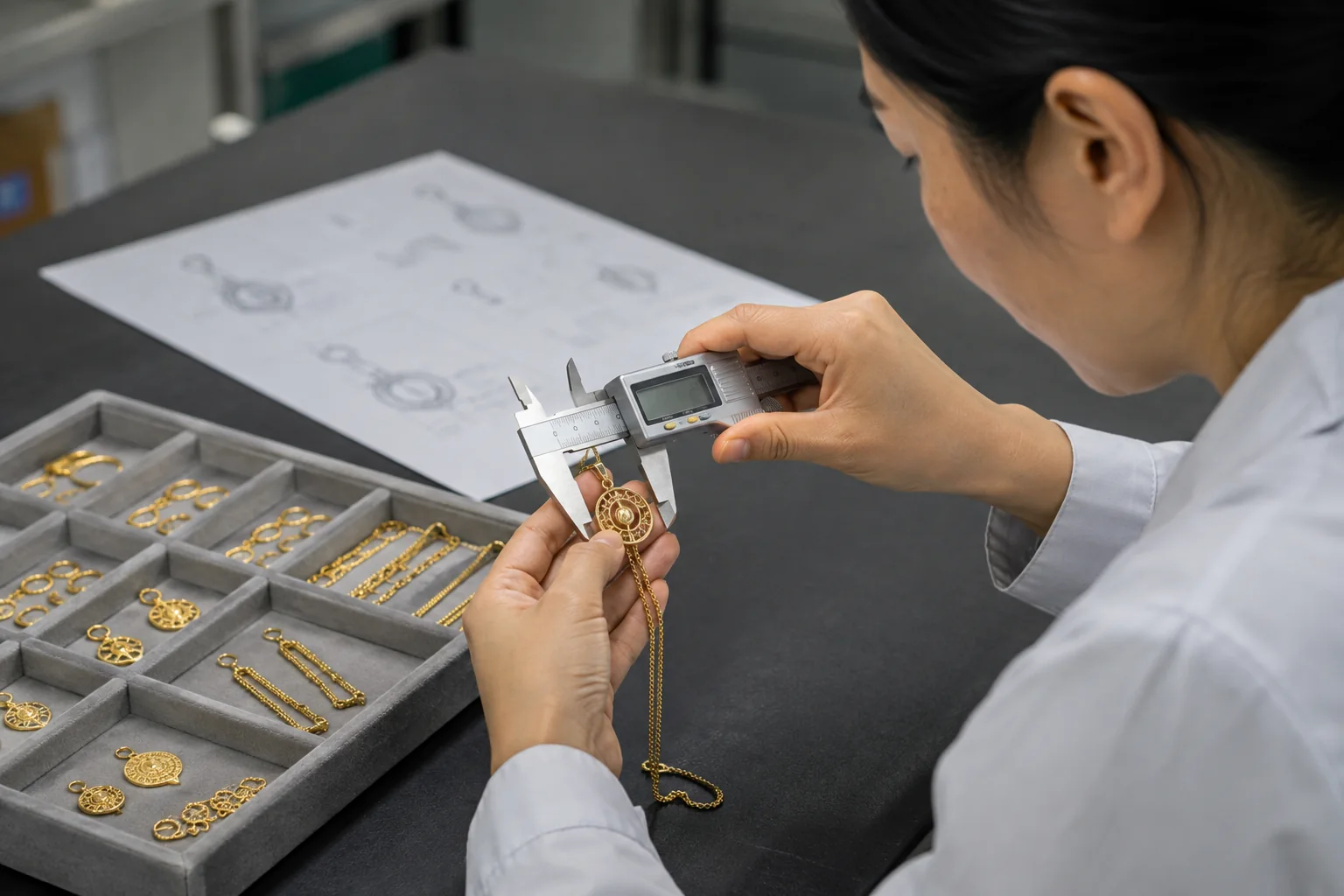
Use a physical sample whenever the choice affects feel, fit, balance, closure, finish, attachment points, scale, or package interaction. A photo can explain design direction, but it cannot reliably establish the production-ready condition of a finished jewelry SKU. During the sample review, look at the product from the perspective of the buyer, retailer, customer, packer, and shipment inspector—not only from the perspective of the original design image.
Set clear acceptance criteria
Write acceptance criteria in observable language. “Premium,” “good quality,” and “same as photo” are not workable inspection instructions by themselves. State what will be reviewed: a physical measurement, a component position, a finish reference, a closure operation, a packing configuration, a count, or an approved artwork file. Where a normal visual variation is acceptable, agree it before bulk production so the factory and buyer are not making a new interpretation during shipment inspection.
Avoid generic superlatives or durability promises that are not tied to a defined, supportable statement. A claim may need qualification even when the supplier’s material description is accurate. If a buyer needs a legal, regulatory, medical, customs, or market-specific conclusion, the relevant evidence and qualified advisers should be used for that specific product and destination. A supplier record, factory testing request, or third-party document has a defined subject, date, method, and scope; it should never be treated as a universal product approval.
Build a controlled approval trail
The approval trail should connect the quotation, product brief, sample, artwork, packaging, and inspection checklist. When an item changes, record the revision, the reason, the possible cost or timing effect, the downstream documents affected, and the final approval. This avoids a common failure in B2B jewelry: one team approves a visual sample while another works from an earlier packaging file or an older component assumption.
For installation preparation in a commercial jewelry program, confirm that the final product can be assembled, packed, labeled, photographed, counted, and handed over using the same approved reference. Customer requirements are easier to meet when they are visible in the current revision rather than scattered across messages. The record also gives the buyer a practical way to review a repeat order without starting from memory.
Make factory testing and shipment inspection relevant
Factory testing is useful only when its purpose, product configuration, method, and decision rule are stated. The same discipline applies to shipment inspection. Before dispatch, compare representative finished goods and pack-out with the approved record for SKU identity, quantity, visible finish, critical dimensions, components, branding, product application, unit packaging, labels, cartons, and any buyer-defined acceptance points.
Do not turn a pass on one inspected sample or a material document into a guarantee about every future item or use condition. Retain the factual result, record any exception, and decide whether it affects the release. This transparent approach is more credible with retailers and is more useful when a buyer later needs to investigate a return, update product copy, or plan a reorder.
Mid-article CTA: prepare a quote-ready brief
Need help with jewelry plating claims? Send OWGOW your reference images, estimated quantity, target market, material and finish direction, packaging idea, and the points your team needs to approve. We will identify the production information needed for a practical quote and sample discussion. [Send Your Requirements](../../index.html#contact) or email [info@owgow.com](mailto:info@owgow.com).
A five-step buyer workflow
- Define the decision. Write down the product role, the exact SKU, related variants, customer requirements, and the commercial question to be decided. This prevents a supplier from quoting a look-alike when the buyer needs a specific configuration.
- Create a comparable brief. State the material and finish direction, dimensions, components, product application, quantity, branding, packaging, target market, and any documentation question. Use the same brief for every supplier comparison.
- Review the finished sample. Check the product, presentation, and relevant functional points together. Keep a dated image set or physical reference, then record the approval decision and any open items.
- Release the current revision. Link the approved configuration to the quotation, product data, artwork, packing instruction, factory testing plan where appropriate, and shipment inspection checklist. Do not release bulk production with a known conflict between these records.
- Close the loop after dispatch. Preserve the inspection result, carton data, handover documents, buyer feedback, and any corrective action. Use this evidence to improve the next quote, collection update, or reorder.
Buyer questions to settle before bulk production
Ask whether the product identity is unambiguous, whether the selected option supports the intended product application, and whether each customer-facing claim is grounded in the actual configuration. Confirm what the MOQ covers by SKU, finish, component, logo, and packaging route. OWGOW’s standard planning MOQ is 100 pieces, subject to confirmation for the actual configuration. Keep sample planning and bulk production timing separate from freight timing, payment, import formalities, and other events outside the physical production scope.
Also ask what happens if a component, artwork file, finish direction, packaging format, or quantity split changes. A controlled change may require a revised sample, re-quote, updated product copy, new packaging proof, or different inspection points. Making that path clear before production prevents avoidable scope drift.
Use source material transparently
For further context, review FTC Jewelry Guides. Use it to frame the buyer’s question, not as a shortcut to a market conclusion. Verify that any source, report, factory record, product data, or customer-facing statement applies to the correct SKU, market, and date. Where product claims have legal or consumer-protection implications, qualified advice should guide the final decision.
Before you brief the supplier
Prepare a concise file set: the current product image or drawing, the relevant dimensions, material and finish direction, component list, estimated quantity, logo or artwork files where relevant, packaging direction, target market, and the question that needs a decision. Give each file a clear name and revision date. This makes it easier for a supplier to distinguish approved information from inspiration or obsolete references.
Ask the supplier to identify assumptions rather than filling gaps silently. For example, request confirmation of the proposed construction, components, unit packaging, sample route, and inspection scope in the quotation. If the project includes a product claim, label, care instruction, or market-specific document, note whether the supplier is expected to provide factual input, a defined document for review, or only the finished SKU data. This keeps commercial, technical, and compliance responsibilities visible.
Align the teams that use the decision
The merchandiser, designer, buyer, supplier, quality reviewer, retailer, and fulfillment team each use the product information differently. The merchandiser needs the collection role and price position. The designer needs a controlled visual and construction reference. The supplier needs measurable manufacturing and pack-out instructions. The quality reviewer needs observable acceptance points. The retailer needs accurate item and presentation information. The fulfillment team needs the current SKU, unit-pack, and carton data. One master record avoids asking each team to reconstruct the decision from a different source.
Use a short release meeting or written sign-off for material changes. Confirm which record is the source of truth, what changed from the prior revision, whether the approved sample is still valid, and which downstream files must be updated. This is especially valuable where a collection will be sold in Europe, North America, and the Middle East: the product may share a physical configuration while its required labels, product copy, route, or buyer documentation need market-specific review. Keep those market decisions attached to the SKU rather than assuming that one commercial presentation fits every destination.
Common mistakes that weaken the order
Treating an email thread as the production specification
Messages can capture useful detail, but they are difficult to inspect as a controlled product record. Move the approved decision into a dated SKU-level brief, sample record, artwork file, or packing instruction. This gives the buyer and supplier one reference to use during production and shipment inspection.
Separating packaging from product review
Jewelry can be affected by movement, abrasion, pressure, entanglement, product orientation, or a display component that does not fit. Review the actual item in its intended card, pouch, box, insert, and inner-pack configuration. When the product changes, check the packaging again before the bulk packing release.
Writing claims before the SKU is settled
Product copy should describe the item the buyer has actually approved. Do not copy broad material, care, performance, origin, or skin-contact language from another product or competitor listing. Build the line sheet, product page, and packaging information from the approved product-data record.
FAQ
Can a supplier quote this decision from one product photo?
A photo can begin a feasibility discussion, but a reliable quotation needs the finished product configuration, material and finish direction, dimensions, components, quantity, branding, packaging, target market, and any relevant inspection or documentation requirements.
Does the 100-piece MOQ apply to every variation?
OWGOW’s standard planning MOQ is 100 pieces, subject to confirmation for the specific SKU, material, finish, component set, branding, packaging, and quantity split. Ask for a written SKU-by-SKU scope before approving a quotation.
What should be checked before shipment?
Compare selected finished goods with the approved sample and written record for product identity, quantity, finish, critical dimensions, components, branding, unit pack, labels, carton details, and buyer-defined acceptance criteria.
Can a document or test result prove every future product is suitable?
No. Documents and test results have a defined sample, method, date, and scope. Review them against the actual finished SKU, intended claim, and destination requirement, and seek qualified advice for decisions with legal consequences.
Conclusion
Before publishing coating or plating language, buyers should match every claim to the exact product configuration, supported material information, approved finish, selling market, and product-page context, then avoid expanding the claim beyond what the evidence supports. A structured buyer brief, a controlled sample decision, relevant factory testing, and a focused shipment inspection give procurement teams a more reliable way to move from product idea to wholesale release. They also make internal approvals, retailer communication, and future reorders easier to manage because each decision is connected to evidence rather than memory.
CTA: start a controlled sourcing conversation
Share your product reference, estimated quantity, target market, material and finish direction, packaging needs, and the question your team needs answered. OWGOW will help organize the details needed for a clear next step. [Get a Quote](../../index.html#contact) or email [info@owgow.com](mailto:info@owgow.com).
ARTICLE TAGS
RELATED RESOURCES
Keep building the brief
Use these buyer resources to connect this decision with the next specification, approval, or sourcing step.
- Sustainability & compliance hub →
- How to Review “Hypoallergenic” Jewelry Claims Before Wholesale Launch →
- How to Choose a Private Label Jewelry Manufacturer →
External buyer reference: European Chemicals Agency: REACH