Introduction
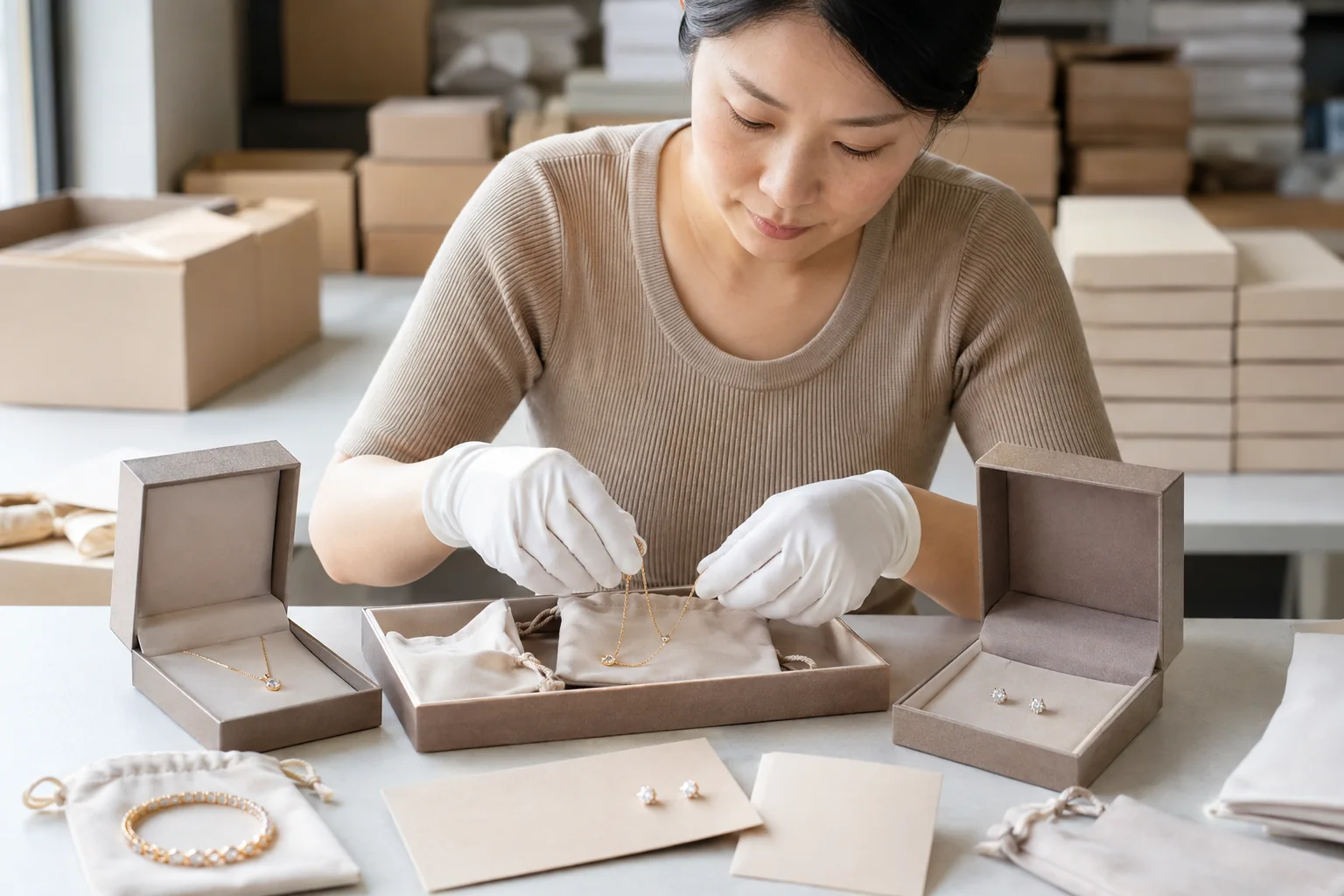
Private-label buyers often make an accurate jewelry decision and then discover that the packaging plan was too vague. A box may be oversized for the pendant, a card slot may catch a chain, an insert may create pressure on a stone, a logo may be too small to reproduce cleanly, or a low volume may change the packaging unit economics. These are not merely visual details: they can affect the customer’s first impression, packing consistency, freight space, and the commercial feasibility of an order.
OWGOW plans jewelry projects from a 100-piece MOQ. Sample planning is typically around three days after the design direction and materials are confirmed, with standard bulk production typically around 7–10 days after scope approval. Packaging MOQ, artwork readiness, print process, material availability, and revisions may add separate decisions. This guide helps a buyer make those decisions visible without presenting a universal MOQ or delivery promise.
The six keyword themes this guide serves
This page targets six tightly connected buyer queries:
- jewelry packaging MOQ
- custom jewelry packaging MOQ
- jewelry box MOQ
- jewelry display card MOQ
- private label jewelry packaging
- jewelry packaging sample
Why the packaging MOQ is not automatically the jewelry MOQ
The jewelry order and the packaging order can share a launch date, but they do not always share the same minimum. Jewelry MOQ is influenced by the SKU, material, finish, components, and production configuration. Packaging MOQ can be influenced by paper or textile material, board thickness, box construction, insert shape, logo treatment, print colours, foil or embossing, card holes or slots, pouch construction, labels, and the supplier’s production setup.
Treat the two as linked but separate workstreams. The buyer should decide whether the packaging is a shared collection asset, a SKU-specific asset, a seasonal item, or a reusable core format. A neutral card or pouch may be used across several compatible SKUs; a rigid fitted insert normally needs more specific approval. This distinction informs quantity planning, reorder risk, and the way packaging cost is allocated to a collection.
| Packaging decision | Buyer question | Commercial effect |
|---|---|---|
| Format | Card, pouch, box, sleeve, insert, or combination? | Changes protection, display, and packing work |
| Branding | Print, foil, embossing, label, or no logo? | Changes artwork, process, and MOQ assumptions |
| Product fit | Does the complete finished SKU sit correctly? | Prevents rubbing, tangling, pressure, and movement |
| Quantity | Is the pack shared across SKUs or dedicated? | Determines procurement and allocation logic |
| Reorder plan | Will this design remain current after the first run? | Helps avoid unusable packaging stock |
Brief the package with the same discipline as the jewelry
A production-ready packaging brief contains more than a logo file. Identify the outer dimensions, material or substrate direction, colour, finish, artwork file and revision, logo position and size, print method where known, insert or card layout, label or barcode area, unit count, target SKU list, intended market, and buyer approval points. When a necklace, earring, bracelet, ring, or set needs specific protection, describe how it will be held, not only what the closed box should look like.
For example, a necklace pack should identify the card slots or restraint method, pendant position, and whether the chain can move or catch during packing. An earring card should identify post-hole position, backing treatment, and the clearance needed inside a pouch or box. The product application matters: a gift-ready box, a retail display card, and a mail-order protective pack can have different requirements even when they contain the same jewelry.
Do not approve artwork in isolation
Artwork approval and physical pack-out approval solve different questions. Artwork proof checks spelling, layout, logo treatment, and visual hierarchy. A physical packaging sample checks fit, friction, compression, closure, opening experience, and packing consistency. Keep the approved files and the approved physical reference together, with a date and revision. If the jewelry changes after the packaging sample is approved, review the interaction again.
Build an MOQ plan around realistic use
Start with the planned jewelry quantity by SKU, then decide how many packs will be needed for initial sales, sample units, replacements, photographs, quality checks, and a sensible contingency. Do not assume that an extra packaging quantity has no value or no risk. Plain, reusable cards or pouches can support future orders if the format and branding remain appropriate. Highly seasonal, SKU-specific, or date-specific packaging can become stranded stock after a design or logo change.
| Planning input | Record it this way | Why it prevents waste |
|---|---|---|
| Sellable units | Quantity by SKU, finish, and market | Links each pack to a real product plan |
| Shared formats | List compatible SKUs and size limits | Shows whether a common card or pouch is practical |
| Reserve quantity | State purpose: QA, photography, replacement, or retail | Avoids unexplained over-ordering |
| Artwork status | Draft, proofed, or approved revision | Prevents production from using an old logo file |
| Reorder assumption | Core, seasonal, or one-off | Helps choose between flexibility and bespoke fit |
There is no honest blanket answer to “what is the MOQ for a jewelry box?” The practical answer depends on the box construction, material, finishing process, print requirements, insert, and supplier setup. Ask for the MOQ by format and revision, and ask what changes would trigger a different minimum or price. That gives the buyer a comparable basis for choosing between a stock-style presentation, a semi-custom option, and a fully custom pack.
Compare packaging routes before committing the artwork
Buyers often have three practical routes. A stock-style format uses an existing card, pouch, or box construction with limited adaptation; it can be useful for an initial test when fit and presentation are still acceptable. A semi-custom format applies controlled branding, a selected colour, or a standard insert to an existing construction; it can support a more branded launch without treating every physical dimension as new development. A fully custom format uses a dedicated size, structure, insert, print treatment, or presentation sequence and needs the most careful sample, MOQ, and reorder planning.
The right choice depends on the product role and the buyer’s evidence, not on which option sounds most premium. A core necklace collection may justify a tested branded card that can support several compatible chain lengths. A limited seasonal pendant may be better served by a flexible pack that protects the item and does not create excessive obsolete stock. For every route, ask the supplier to show exactly what is standard, what is customised, and what must be approved before the price applies.
| Route | Suitable when | Buyer should validate |
|---|---|---|
| Stock-style | Initial market test or flexible assortment | Product fit, logo treatment if any, and retail readiness |
| Semi-custom | Brand needs a recognisable but repeatable presentation | Artwork, colour, print result, and compatible SKU range |
| Fully custom | Product or brand experience needs dedicated construction | Dimensions, insert fit, MOQ, sample revision, and reorder plan |
Cost the complete presentation, not only the printed item
Packaging cost can include more than the visible box or card. Consider protective sleeves, tissue or pads, anti-tarnish materials where selected, labels, care cards, inserts, assembly work, inner packs, and carton configuration. These items should be neither assumed nor exaggerated. Put them on the quotation and pack-out record so the buyer can determine which requirements are essential to the customer experience and which are optional additions.
For a collection with several SKUs, use a simple allocation rule. A common display card, pouch, or care card may be allocated across compatible units. A fitted insert, special box, or SKU-specific label may need to remain with the individual product cost. State the method in the buyer’s internal costing sheet. It enables merchandising and finance teams to see the difference between a shared brand asset and a product-specific packaging decision.
Set the release gate before printing starts
The release gate should include the approved product reference, packaging specification, artwork proof, packaging sample, quantity list, and inspection checklist. If any of those has a new revision, pause and decide whether a revised sample or quotation is needed. This is especially important when the buyer makes a late logo correction, changes a necklace length, alters a pendant profile, adds a barcode, or changes the intended market. A clear release gate is a safer control than relying on an informal message shortly before bulk packing.
Mid-article CTA: make the packaging brief quote-ready
Planning private-label jewelry packaging? Send OWGOW your product reference, quantity by SKU, logo file or artwork status, preferred card, pouch, or box format, and selling market. We will identify the details needed for a controlled product-and-packaging quotation. [Send your requirements](../../index.html#contact) or email [info@owgow.com](mailto:info@owgow.com).
Test the whole unit, not just the package
Packaging should be checked with the finished jewelry, including any chain, pendant, stone, clasp, earring backing, tag, care card, pouch, insert, and outer carton that will be used. A useful sample review asks whether the product can be packed consistently, whether it stays in position, whether the surface is protected, whether the logo and label match the approved file, and whether an ordinary unpacking produces a retail-ready item.
This is where factory testing and shipment inspection become relevant. The buyer can define observable packaging checks—correct SKU, approved artwork revision, clean print, card alignment, box closure, pouch construction, product fit, labels, count, and carton marks—rather than asking an inspector to interpret “premium packaging.” During shipment inspection, selected finished packs should be opened and compared with the approved production reference. Document deviations accurately and resolve them against the written criteria.
Link packaging decisions to freight and fulfillment
A stronger protective box can be the right choice, but it may alter pack size, master-carton count, handling, and freight assumptions. Conversely, a compact card may reduce volume but fail to protect a heavy pendant or long chain. Discuss the product, unit pack, inner pack, and carton together before bulk packing. This is installation preparation for a commercial program: retail, warehouse, quality, and logistics teams need the same practical reference.
Keep environmental claims precise
If a packaging design will use sustainability language, avoid broad claims that the buyer cannot support. The U.S. Federal Trade Commission’s Green Guides explain that environmental marketing claims need appropriate substantiation and that broad, unqualified claims can mislead. This is not legal advice and does not decide what may be claimed in a particular market. It is a reason to describe a specific, supportable attribute rather than calling a package universally “eco-friendly.”
For the same reason, do not turn a factory audit, material statement, or third-party document into a blanket product or packaging claim. Review the document’s subject, scope, date, method, and conclusion against the exact configuration and intended market. OWGOW can discuss BSCI, ISO, SGS, REACH, and RoHS-related documentation for review where applicable, but buyers should verify what is relevant to their actual product and destination.
A five-step private-label packaging workflow
- Map the sellable unit. State the jewelry SKU, product application, market, and pack format needed for each unit.
- Set the packaging brief. Confirm size, materials, artwork, logo treatment, protective features, and quantity logic.
- Approve two references. Approve the artwork proof and the physical product-inside-pack sample as dated revisions.
- Release production deliberately. Align purchase quantity, artwork, pack-out instructions, inspection criteria, and carton plan.
- Preserve the reorder record. Keep files, samples, packing data, shipment inspection notes, and customer requirements for the next buying cycle.

FAQ
Can a jewelry order use generic packaging for the first run?
Often it can, if the generic format protects the actual SKU and fits the retail plan. The buyer should still approve the finished product inside that format and confirm whether the presentation supports the intended brand and market.
Should the packaging sample be approved before bulk jewelry production?
Yes, when packaging affects product protection, fit, branding, or the commercial launch plan. Reviewing the actual item in its final pack gives the buyer a better control point before bulk packing starts.
Can the same display card work for every jewelry SKU?
Only if the product dimensions, weight, attachment points, retail information, and packaging interaction are compatible. Test representative samples rather than assuming visual consistency equals physical compatibility.
What should be included in the final packaging inspection?
Check the product and package together: SKU, quantity, visible finish, artwork revision, logo, label, product fit, protective components, pack assembly, carton count, and shipping marks against the agreed specification.
Conclusion
Jewelry packaging MOQ is a sourcing decision, not a last-minute print order. Separating its quantity logic from the jewelry MOQ, approving the physical product inside its final pack, and documenting artwork, fit, inspection, and reorder assumptions gives a private-label buyer more control over cost, presentation, and delivery readiness.
CTA: prepare your product-and-packaging brief
Share your jewelry reference, estimated quantity, packaging concept, artwork status, and target market. [Get a quote](../../index.html#contact) or email [info@owgow.com](mailto:info@owgow.com).
ARTICLE TAGS
RELATED RESOURCES
Keep building the brief
Use these buyer resources to connect this decision with the next specification, approval, or sourcing step.
- Sustainability & compliance hub →
- Jewelry Gift Set and Bundle Planning for Private-Label Brands →
- How to Choose a Private Label Jewelry Manufacturer →
External buyer reference: ICC Incoterms® 2020