Introduction
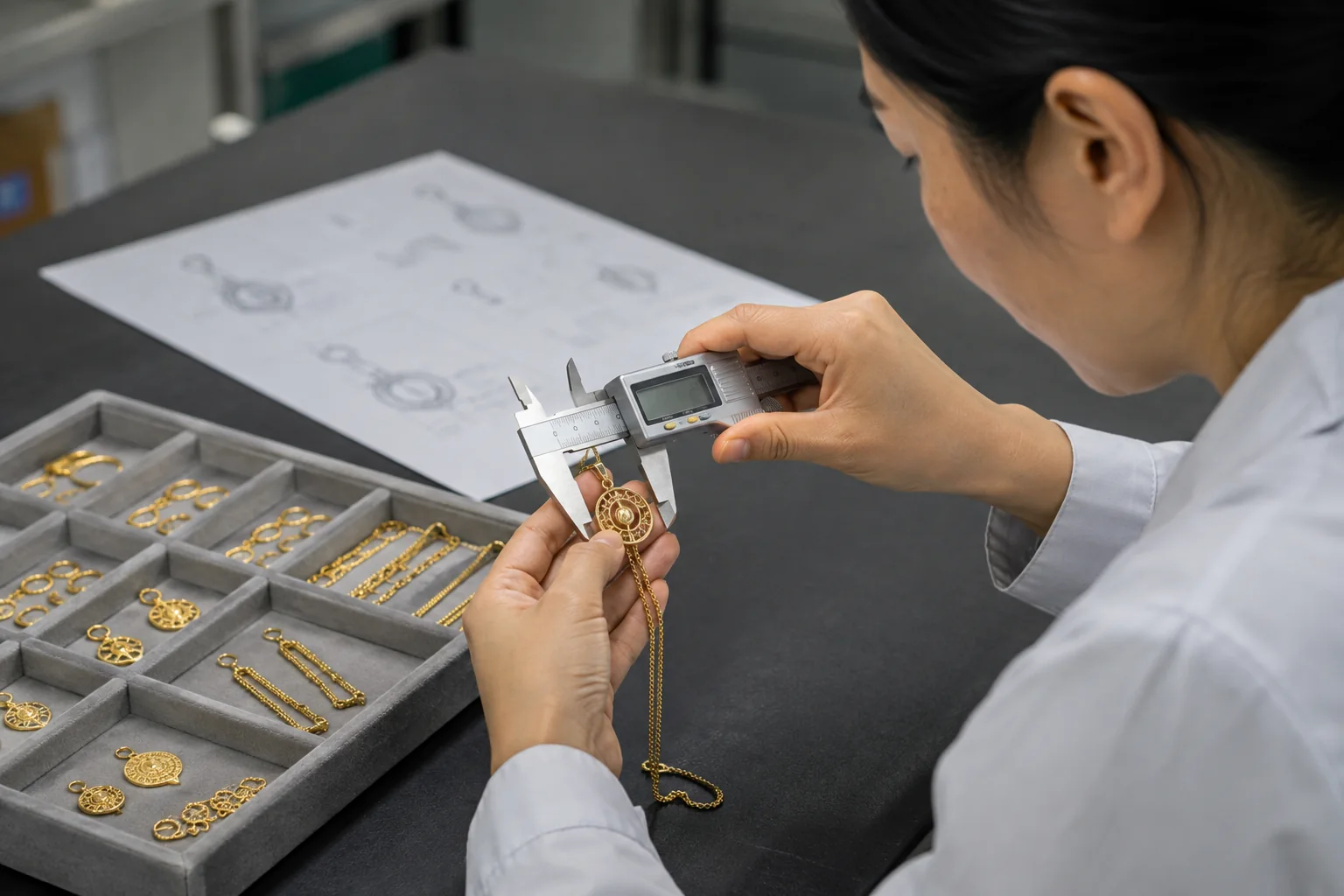
The purchase order is where a promising private-label jewelry project becomes a production commitment. It is also where small omissions become costly. A necklace can be priced correctly but released with the wrong chain length; a box can be approved but missing from the PO; an artwork revision can be sent by email without replacing the earlier file; or a buyer can expect a destination document that the supplier was never asked to prepare.
This guide is a commercial operating framework, not a substitute for legal, customs, tax, or freight advice. Contract terms and import responsibilities depend on the transaction and market. Where the buyer uses Incoterms® rules, the current ICC Incoterms® 2020 guidance is an authoritative starting point; the buyer should confirm the chosen rule, named place, and obligations with qualified advisers and the freight parties involved.
OWGOW supports B2B jewelry projects from a 100-piece MOQ. Samples are typically planned in about three days after design and material direction are confirmed, and standard bulk production is typically around 7–10 days after scope approval. A purchase order should not treat those general planning times as a guarantee. It should state the product-release date, the delivery assumption, and the dependencies that could affect handover.
The six keyword themes this guide serves
This page answers six connected B2B procurement queries:
- jewelry purchase order checklist
- wholesale jewelry purchase order
- private label jewelry PO
- jewelry order confirmation
- jewelry production order
- jewelry PO template
What a jewelry PO must control
A purchase order is not the same as an early request for quotation. The RFQ asks what can be made and on which commercial assumptions. The approved sample confirms a product direction. The PO should lock the agreed version for bulk production and link it to the relevant quotation, sample, pack, and handover instructions. If a point remains undecided, identify it as an open release item rather than writing a vague instruction.
| PO section | Minimum information | Why it matters |
|---|---|---|
| Buyer/supplier reference | Legal entities, PO number, issue date, buyer contact email | Creates a traceable commercial record |
| Product line | SKU, revision, image/reference, quantity, finish, size | Stops a generic title from replacing a product specification |
| Price/scope | Unit price, currency, included/excluded items, quotation reference | Makes comparison with the approved quotation possible |
| Packaging | Unit pack, card/pouch/box, artwork revision, quantity logic | Prevents an approved pack being omitted from the release |
| Delivery/handover | Agreed rule, named place where applicable, timing assumptions, documents | Aligns supplier and buyer logistics expectations |
| Quality/release | Approved sample, checks, selected inspection scope, discrepancy route | Gives quality teams observable points to compare |
Use one unique reference for every variation
Do not describe several visually similar items as “gold earrings” or “green stone necklace.” Assign a distinct SKU and revision to each length, colour, finish, stone option, pack format, or market variation that changes how the item is made, packed, priced, or checked. A photo is useful supporting evidence, but it should not be the only identifier. Record dimensions, material/finish direction, components, and any logo, engraving, barcode, or label requirement alongside the SKU.
This discipline is especially important when a collection uses a shared design in different finishes. The plating direction, logo placement, chain length, or packaging can change both the product and the buyer’s customer promise. A unique reference allows production, inspection, warehouse, and merchandising teams to speak about the same item.
Connect the PO to the approved product reference
For a private label jewelry PO, the approved physical sample and its dated record are usually the strongest production reference. The PO should identify that sample and make any permitted difference explicit. If the sample uses temporary packaging, a different stone shade, an unapproved logo, or an early chain length, write the bulk direction clearly. Otherwise the buyer creates two potentially competing “approved” versions.
| Reference | Link it in the PO as | Buyer check |
|---|---|---|
| Approved sample | Sample ID/date, image set, holder/location | Is the bulk version intended to match it exactly? |
| Technical brief | Document name, revision, controlled file location | Are dimensions and component details complete? |
| Quotation | Quotation number/date and accepted commercial scope | Are packaging, tooling, and extras visible? |
| Artwork | File name, revision, approval date | Does it match the final SKU and target market? |
| Inspection plan | Checklist version and acceptance description | Can the finished item be checked objectively? |
The product application belongs here as well. Retail display, gifting, e-commerce shipment, distributor fulfillment, and event merchandise can need different pack-out, care content, barcode, or carton handling. The words “standard packaging” have no value unless the standard is identified and the actual product fit is approved.
Make commercial scope visible line by line
Unit price is only useful when its scope is understood. For each jewelry production order, state whether the price includes the agreed product configuration, components, finish, packaging, artwork/print treatment, assembly, inspection scope, inner pack, master carton, and any other agreed item. Do not assume that a quoted product price includes a later request for a custom box, separate care card, barcode label, or revised engraving.
For delivery, state the agreed commercial term and named place if the parties use an Incoterms® rule, but do not use a three-letter term without context. The buyer should make sure that invoice, packing list, shipment handover, freight booking, and insurance assumptions are consistent with the order. OWGOW’s [Incoterms guide for jewelry importers](../incoterms-for-jewelry-importers-exw-fca-fob-guide/) and [landed-cost guide](../jewelry-landed-cost-import-planning-guide/) are related planning resources, not a replacement for formal trade advice.
Do not mix assumptions and commitments
A sample target, material availability assumption, or provisional launch date can be useful in a PO—but label it accurately. A commitment should have an agreed condition and owner. For example, “bulk timing is planned from written approval of the final sample and complete artwork” is clearer than “ships in ten days.” It makes the dependency visible without creating an unsupported promise.
Mid-article CTA: make your PO ready for quotation and bulk release
Preparing a jewelry purchase order? Send OWGOW your SKU list, product references, target market, quantity, packaging direction, and delivery assumptions. We can identify the details needed for a controlled quotation, sample plan, and bulk-release brief. [Send your requirements](../../index.html#contact) or email [info@owgow.com](mailto:info@owgow.com).
Write a practical quality and inspection section
The quality section should describe observable conditions, not generic phrases such as “premium quality.” Refer to the approved sample and specify what is to be checked: correct SKU, finish/colour direction, visible surfaces, dimensions where agreed, closure function, component attachment, stones or decorative parts, engraving/logo, packaging, care insert, quantity, and carton allocation. If the buyer needs a specific test, document the method, sample basis, acceptance criteria, responsible party, and when the result is required.
Factory testing is useful only when it is defined. A routine visual check, closure-operation check, or package fit review should be described as such; it should not be presented as a laboratory result. Shipment inspection should also have a clear scope. It can compare selected finished units and packing against the approved reference, but cannot prove every unit or replace destination-market analysis.
| Release point | PO instruction | Evidence to retain |
|---|---|---|
| Pre-production | Confirm final sample, material/finish, artwork, pack | Dated approval record and revision list |
| In-process | Check agreed product-specific points | Inspection record or controlled quality note |
| Pre-shipment | Review selected finished packs, SKU/count/carton allocation | Shipment inspection findings and photos |
| Handover | Issue agreed documents and packing data | Packing list, invoice, approved handover record |
Installation preparation is the buyer’s internal equivalent of this work. Warehouse teams need carton and SKU data, marketing needs the final product/pack reference, customer service needs care content, and procurement needs the approved commercial scope. A well-written PO makes these downstream handovers more reliable.
Control changes after the PO is issued
Changes are normal; uncontrolled changes are not. The PO should name the person or process that can authorize a change and require a dated record stating what changed, why, effect on price/timing/quantity, new document revision, and approval. Do not ask production to implement a change from an informal message while the controlled PO and drawing still show the earlier version.
Common changes include a new finish, revised pendant size, component substitution, different logo file, packaging adjustment, market label, quantity change, or delivery destination. Each can affect customer requirements, cost, lead time, and inspection. When a change affects product fit, visible finish, packaging, or claims, consider whether a revised sample needs approval before bulk work continues.
Use OWGOW’s [sample revision control guide](../jewelry-sample-revision-control-change-log-guide/) and [change-request guide](../jewelry-change-request-management-after-sample-approval/) to structure the record. The purpose is not bureaucracy; it is to stop an old drawing and a new email from both appearing “approved.”
A seven-step jewelry PO release workflow
- Reconcile quotation and product brief. Confirm that the commercial scope matches the actual SKU configuration.
- Lock the approved reference. Identify the physical sample, images, technical document, and artwork revision.
- List every sellable variation. Separate SKU, finish, size, packaging, market, and quantity differences.
- Add production and quality controls. State required checks, documentation, and escalation route.
- Align delivery and handover assumptions. Record the agreed term/route, named place where applicable, packing, documents, and timing dependencies.
- Define change control. Require written approval before a scope-affecting change is released.
- Issue one controlled order pack. Send the same dated set to product, quality, packaging, and logistics owners.
Resolve the common PO failure modes before release
The strongest jewelry PO is usually not complicated; it is complete enough that a person who did not attend the original discussion can identify the item, the approved version, the commercial scope, and the next action. Before issuing it, perform a short reconciliation with the quotation and sample record. This takes less time than sorting a mismatch after components have been allocated or cartons have been packed.
| Common failure mode | Why it causes friction | PO control that prevents it |
|---|---|---|
| Quantity is correct but SKU mix is unclear | Production cannot tell which finish, size, or pack receives each unit count | List quantity by unique SKU and revision, with a total reconciliation |
| Artwork arrives separately from the PO | A previous logo, label, or card file can remain in the production pack | Name the controlled artwork file and approval date in the line item |
| “Same as sample” is the only specification | The sample may contain temporary packaging or an unapproved detail | State the sample ID and all permitted bulk differences explicitly |
| Freight wording is incomplete | Supplier, buyer, and forwarder may plan different handover responsibilities | Record the agreed rule, named place where applicable, and document expectations |
| Late marketing/retail request | Product, pack, or label changes arrive after release | Use a written change record with owner and impact decision |
| Inspection is described as “full QC” | No one can determine what was checked or compared | Define the product/pack points, sample basis, and record expected |
Run a line-by-line “four-way match”
Before bulk release, compare four items: the PO, the accepted quotation, the approved sample/specification, and the final artwork/packaging file. For each SKU, confirm the reference, quantity, finish, size, price scope, pack, and destination requirement. If any of the four sources differs, stop and create a controlled clarification. Do not quietly choose whichever document was sent last.
This approach is particularly useful for orders with shared components. A collection may use the same chain across several pendants, the same display card across multiple earrings, or the same box across a gift set. The PO should show whether an item is shared, SKU-specific, or a separately purchased brand asset. It helps the buyer understand both allocation and reorder exposure without treating common packaging as an invisible free item.
Keep the confirmation usable after shipment
The order record should remain searchable after dispatch. Keep the final PO, order confirmation, revision log, approved sample images, packing list, inspection record, and commercial correspondence together under a stable internal reference. If a retailer later reports an issue, this is the evidence set that lets the brand determine what was ordered, what was approved, and what was handed over. The same record also improves reorder planning because it shows which instructions were actually used, rather than only the original design intention.

FAQ
Is a jewelry purchase order enough without an approved sample?
It can be a commercial order document, but a private-label or custom product usually needs a clear production reference. If a physical sample is not available, the buyer should use a controlled technical specification, artwork, images, and defined acceptance points—and understand the remaining risk.
What must be on a wholesale jewelry purchase order?
Include legal/commercial references, SKU and revision, quantity, price/scope, product specification, packaging, approved artwork, quality/inspection points, delivery/handover assumptions, required documents, and change-control instructions.
Can a buyer change the finish after a jewelry PO is issued?
Yes, if the parties document and approve the change before it is implemented. The record should state the affected SKU, revised reference, cost/timing/quantity impact, and whether a revised sample or inspection point is needed.
How should a jewelry order confirmation be checked?
Compare it against the PO, accepted quotation, approved sample, SKU/quantity list, artwork, packaging specification, delivery assumptions, and document requirements. Resolve any mismatch in writing before bulk release.
Conclusion
A jewelry purchase order is the buyer’s practical bridge from sampling to controlled bulk production. Lock the approved product version, make commercial and packaging scope visible, set usable inspection points, align delivery assumptions, and record changes deliberately. With one coherent order pack, a private-label buyer can reduce preventable ambiguity at production, shipment, and retail handover.
CTA: prepare an order-ready jewelry brief
Share your product references, estimated quantities, packaging concept, target markets, and delivery assumptions. OWGOW can help organize the details needed for a practical jewelry PO, sample review, and production conversation. [Get a quote](../../index.html#contact) or email [info@owgow.com](mailto:info@owgow.com).
ARTICLE TAGS
RELATED RESOURCES
Keep building the brief
Use these buyer resources to connect this decision with the next specification, approval, or sourcing step.
- Private-label hub →
- Custom Jewelry MOQ Guide for Brand Launches →
- Jewelry Reorder Planning for Wholesale Buyers: When to Replenish a Proven SKU →
External buyer reference: FTC Jewelry Guides