Introduction
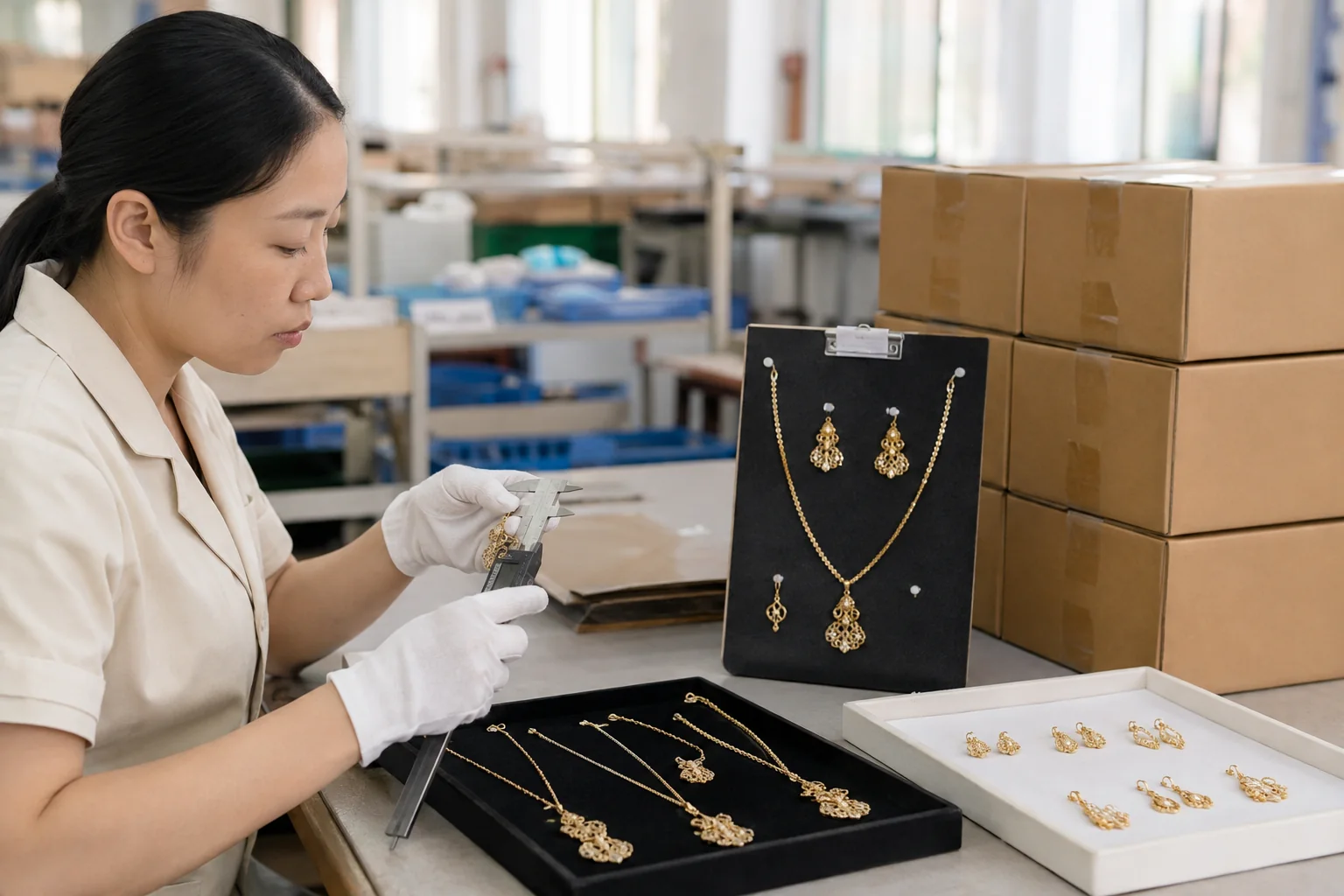
For private label jewelry, the approved sample is not simply the attractive piece photographed for a launch. It is the reference that connects product design, material selection, quality control, packaging, and shipment release. If the sample is approved casually, the production team and buyer may be looking at different versions of “the same” product when bulk goods are ready.
That gap is expensive. It can lead to color disputes, missing branding, short chains, weak clasps, inconsistent stone selection, packaging rework, delayed shipment inspection, or goods that cannot be released to a retailer. The solution is not more email. It is a controlled approval record and an inspection plan agreed before bulk production begins.
This guide shows how a buyer can move from an RFQ to an approved sample and a practical pre-shipment inspection. It is suitable for earrings, necklaces, bracelets, rings, pendants, natural-stone jewelry, pearls, and private-label packaging. It describes a general B2B process; it is not a substitute for destination-market legal advice or a laboratory testing program.
The short answer: what does “sample approved” need to mean?
A sample is approved only when the buyer has confirmed the exact product revision, material, finish, dimensions, components, branding, packaging, acceptable variation, and inspection criteria in writing. A photo approval alone is not enough for a bulk order because it usually does not control construction, function, or carton presentation.
1. Build the right documents before the sample is made
The sample stage moves quickly when the inputs are clear. Give every document a name, date, and revision number. That makes it possible to identify which file is current when a buyer, sales contact, factory floor, packaging vendor, and inspector are all involved.
Core document set
| Document | What it controls |
|---|---|
| Product brief | Commercial goal, target market, reference image, target retail range, estimated order quantity |
| Technical specification | Materials, dimensions, finish, components, logo, product code, tolerances where critical |
| Artwork pack | Logo files, placement drawing, packaging graphics, barcode or label information |
| Sample request | What the factory must make, sample quantity, revision date, requested review date |
| Approval record | The accepted sample, deviations, photos, sign-off, and any conditions for bulk production |
| Inspection plan | Defect definitions, sample plan, checks, packaging rules, reporting requirements, release authority |
For a necklace, the technical specification should identify chain length, extender length, clasp type, pendant dimensions, pendant orientation, jump-ring size, base metal, finish, stone or pearl type, logo location, and packaging configuration. “Same as photo” is not a specification because the photo may not show the back, the clasp, scale, or material.
Keep a golden sample under control
Many sourcing teams call the final approved physical reference a “golden sample.” It should be labelled with the product code, revision, approval date, and buyer reference. The manufacturer keeps one protected reference; the buyer keeps another. If the sample is later modified, do not overwrite the approval. Issue a new revision, document the change, and confirm whether it affects price, MOQ, testing, lead time, or packaging.
2. Use sample development to test fit, function, and finish—not just design
A good sample review is a product application exercise. Consider how the actual customer will handle the piece: open and close the clasp, wear it next to the skin, put it into the package, remove it from the package, combine it with other items, and place it in a retail display or e-commerce fulfillment process.
Product checks by category
Earrings: verify post straightness, back fit, pair matching, weight balance, stone security, and whether the earring card supports the product without scratching it.
Necklaces and pendants: verify total length, extender operation, clasp action, pendant orientation, chain twist, stone setting, and whether the item tangles after packing and unpacking.
Rings: verify size range, inside comfort, sharp edges, stone seating, plating or coating coverage around the shank, and resizing policy if relevant.
Bracelets: verify circumference, hinge or clasp action, link strength, charm orientation, and repeated-contact points.
Natural stone and pearl designs: agree what constitutes acceptable variation. Natural materials can vary in shade, inclusions, shape, luster, and pattern. The buyer should approve a range rather than expecting every piece to be identical. An approved reference photograph under a defined light source helps, but physical comparison remains important.
At the factory-testing stage, appropriate checks may include dimensional measurement, visual surface review, clasp/hinge function, stone security, component pull checks where applicable, logo position, and packaging fit. The exact test sequence should be appropriate to the product and agreed by the parties. Do not imply that a general factory process proves a particular test result for every SKU.
OWGOW plans standard samples in three days after design direction and materials are confirmed. Custom molds, special stones, new components, packaging artwork, test requirements, or revision cycles can extend that route, so the buyer should treat the date as a scoped plan, not an automatic promise.
3. Write acceptance criteria before the purchase order is released
Acceptance criteria answer the question: what must be true for a lot to ship? They should be measurable where possible and descriptive where measurement is not practical. The buyer does not need a 40-page manual for a first order, but the key controls must be visible.
Examples of clear criteria
- Chain length: 45 cm plus 5 cm extender, measured from clasp end to ring end.
- Logo: positioned on the back tag, centered, legible under normal viewing conditions.
- Finish: matches the sealed approved sample under agreed neutral lighting; no exposed base metal, peeling, obvious stains, or unacceptable color mismatch.
- Stones: secure when lightly checked by the agreed method; no cracked or visibly chipped stones; natural variation within the signed reference range.
- Clasps: open and close smoothly; remain closed during the defined functional check.
- Packaging: one complete product set per labelled unit; correct card, pouch, care insert, barcode, and protective material.
- Cartons: correct assortment count, export marks, dimensions, and maximum gross weight where specified.
Avoid ambiguous criteria such as “high quality” or “nice gold color.” A supplier cannot consistently inspect against those statements, and an independent inspector cannot report a pass/fail result. Translate subjective language into a reference sample, a defect definition, or a stated measurement.
4. Classify defects by buyer impact
Defect categories help a buyer and supplier focus on what matters. The exact definitions should be tailored to the product and customer account, but the following structure is commonly useful:
| Category | Typical jewelry examples | Buyer response |
|---|---|---|
| Critical | Sharp hazard, broken component, unsafe construction, wrong product or missing mandatory information | Stop release; investigate and correct. |
| Major | Loose stone, non-functioning clasp, wrong length, significant finish defect, incorrect logo, missing key packaging item | Reject or rework according to agreed acceptance rules. |
| Minor | Small cosmetic issue outside the approved reference but not affecting function or retail use | Record and assess against agreed sampling criteria. |
Do not automatically classify every visible mark as minor or every functional concern as major. The product’s use, retail customer, and legal obligations determine seriousness. A missing earring back may be operationally major for an e-commerce set; a tiny natural inclusion may be accepted if it is within the agreed material range.
5. Use AQL correctly: it is an inspection method, not a quality claim
AQL—Acceptance Quality Limit—is often requested in sourcing conversations. It is useful only when the parties agree the inspection level, lot size, defect classification, sampling plan, and accept/reject thresholds. It does not mean “the factory may make this percentage of defects,” and it does not replace process controls.
ISO 2859-1:2026 describes AQL-indexed acceptance-sampling schemes for lot-by-lot inspection. In practical terms, a buyer chooses a plan, draws a sample, classifies the findings, and makes a lot-level decision against pre-agreed thresholds. Read the ISO overview for the standard’s scope; use a qualified inspection partner or internal quality lead to select a plan appropriate to the order.
For an initial private-label order, the inspection brief should specify:
- total lot quantity and SKU/color/size breakdown;
- whether the sample is drawn randomly and when;
- defect categories and photographic examples;
- the checks required for each sampled item;
- any critical 100% checks, such as quantity, item identity, branding, or a high-risk functional point;
- the handling of rework and reinspection; and
- who has release authority after shipment inspection.
The purpose is not to add bureaucracy. It is to prevent a debate at the loading stage about what the buyer actually ordered.
6. Inspect packaging and shipment readiness as seriously as the product
Many jewelry issues appear only after the piece enters its retail package. A pendant may arrive tangled. A polished surface may be scratched against a hard card. A pair of earrings may be mismatched after kitting. A care card may use an unapproved logo or omit required consumer information.
The pre-shipment inspection should therefore include a packed-unit review, not just open-tray product photography. Inspectors should check:
- correct product code, color, size, and quantity;
- item condition and function;
- retail package components and placement;
- label, barcode, care-card, and warning copy version;
- inner pack count and carton assortment;
- carton condition, sealing, shipping marks, dimensions, and weight; and
- loading or handover evidence if the buyer’s process requires it.
For brands using display cards, test the installation preparation before mass packing: does the post fit, does the pendant stay centered, does the card bend, and does the product remain presentable after normal handling? A simple packaging trial during sampling can prevent a last-minute manual repack of thousands of units.
7. Link material documentation to the actual order configuration
Compliance evidence belongs in the production plan, not at the end of it. A buyer selling into the European market should identify relevant consumer-product and chemical obligations early. The European Commission’s GPSR information and ECHA’s REACH resources are credible starting points, but they are not a substitute for the buyer’s own market-specific compliance assessment.
When requesting documents, identify the product code, materials, finish, production date/lot where relevant, market, and the requested evidence. A report on an earlier brass component may not demonstrate the status of a later stainless-steel version. Likewise, a facility audit does not replace a product test report. Keep each document with the product revision it supports.
OWGOW can provide BSCI, ISO, SGS, REACH, and RoHS documentation for buyer review where applicable. Confirm scope, date, and product relevance before relying on a document in a retailer submission or consumer claim.
8. Plan rework, reinspection, and escalation before problems occur
Even well-managed production may encounter a finish variation, missing component, print issue, or carton discrepancy. The important question is whether the team can identify the affected quantity, preserve traceability, propose a corrective action, and wait for the buyer’s decision when needed.
Agree the escalation path in advance:
- factory identifies and segregates affected goods;
- supplier sends facts: product code, quantity, photographs, cause if known, and proposed options;
- buyer confirms rework, replacement, concession, or hold;
- revised goods are reinspected under the agreed plan; and
- shipment release is documented by the buyer’s authorized contact.
This process protects both parties. It avoids silent substitution and creates a record that can be used to improve the next order. For reorders, compare the new lot to the retained golden sample and previous inspection reports before approving release.
A practical sample-to-shipment timeline
| Stage | Buyer action | Supplier action | Control point |
|---|---|---|---|
| RFQ | Send commercial brief and target market | Confirm assumptions and quote scope | Revision-controlled quote |
| Sample | Review physical product and packaging | Build requested sample and identify open questions | Dated sample request |
| Approval | Sign off or request changes | Retain approved reference | Golden sample + approval record |
| Production | Confirm any changes in writing | Make to approved revision | First-piece / in-process checks |
| Inspection | Apply agreed plan | Present complete lot and documents | Product + packed-unit + carton report |
| Shipment | Release only after acceptance | Arrange handover and preserve records | Release confirmation |
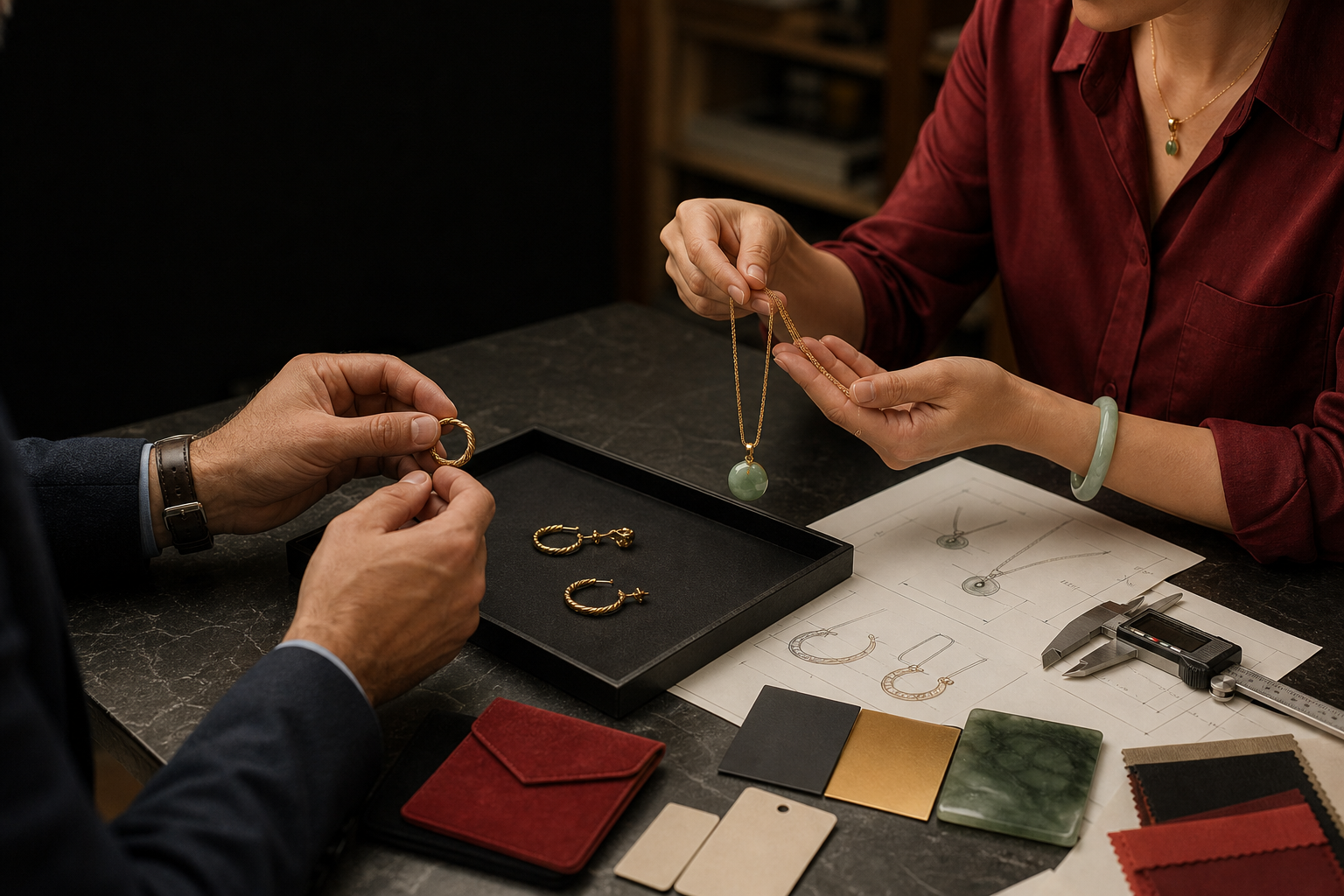
FAQ
What should be included in a jewelry sample approval form?
Include product code, revision, sample date, photos, material, finish, dimensions, components, branding, packaging, allowed variations, open issues, approval decision, and buyer/supplier contacts. Link the approval to the final quotation or purchase order.
Is a pre-production sample the same as a golden sample?
Not always. A pre-production sample confirms the item before full production. A golden sample is the retained, approved physical reference used for production and inspection. For a simple project they may be the same item, but the approval record should state that clearly.
What does AQL mean for jewelry inspection?
AQL is part of an acceptance-sampling approach. It helps define how a sample of a lot is checked and how findings are evaluated. It does not guarantee every unit is perfect and does not replace supplier process control or buyer-defined critical checks.
When should compliance documents be requested?
Request them during product planning, before the material and finish are locked. That gives time to confirm the correct scope or arrange needed testing before bulk production and retail submission deadlines.
Conclusion
A reliable jewelry shipment begins long before cartons are sealed. It begins when the buyer turns a visual idea into a controlled product specification, uses the sample to test actual use and packaging, and documents what must match in bulk production. With an approval record, defect definitions, a fit-for-purpose inspection plan, and clear release authority, both buyer and supplier can make decisions from the same evidence.
CTA: Prepare your next sample for production approval
Share your product reference, target market, required quantity, material/finish preference, branding files, and packaging concept with OWGOW. We will help identify the approval and inspection information that should be settled before bulk production is scheduled. [Contact Us]
---
ARTICLE TAGS
RELATED RESOURCES
Keep building the brief
Use these buyer resources to connect this decision with the next specification, approval, or sourcing step.
- Craftsmanship hub →
- Jewelry Defect Classification: A Practical QC Guide for Buyers →
- Jewelry Golden Sample Guide: How Buyers Set a Bulk Production Reference →
External buyer reference: FTC Jewelry Guides