Introduction

Private-label jewelry buyers often need to make an early decision about an unfamiliar supplier. An audit can support that decision, but only when the buyer understands what it does and does not show. A social audit, management-system document, laboratory report, product sample, and shipment inspection each answer different questions. None should be represented as proof of everything a brand needs to know about a particular product, market, or delivery.
This article provides a due-diligence framework for brands, wholesalers, importers, and procurement teams. It does not certify a site, interpret a specific audit result, or replace a buyer’s legal, customs, product-safety, or ethical-sourcing advice. OWGOW can discuss BSCI, ISO, SGS, REACH, and RoHS-related documentation for review where applicable. Buyers should confirm the document issuer, named site, date, scope, product relevance, and destination-market requirements before relying on any document.
OWGOW supports B2B jewelry projects from a 100-piece MOQ. Sample planning is typically around three days after the approved design and material direction are ready, and standard bulk production is typically around 7–10 days after scope approval. Those commercial timings should begin only after the buyer has identified the controls and evidence needed for the actual order.
The six keyword themes this guide serves
This guide addresses six connected B2B sourcing queries:
- jewelry supplier audit checklist
- jewelry factory audit
- BSCI jewelry manufacturer
- jewelry supplier social compliance
- private label jewelry supplier verification
- jewelry factory due diligence
Start by defining the decision the audit must support
Before requesting documents or booking a visit, write down the intended decision. Is the buyer deciding whether to add a supplier to an approved list, release a sample order, start a private-label collection, accept a corrective-action plan, or place a larger repeat order? The evidence should be proportional to that decision. A small initial sample project may need site identity and communication controls; an ongoing retail program may need more structured documentation, traceability, quality controls, and review of the applicable market requirements.
| Buyer decision | Evidence that can help | Do not infer automatically |
|---|---|---|
| Add supplier to shortlist | Legal entity/site identity, capability discussion, sample references | That the supplier is approved for every future product |
| Release a sample | Design brief, materials direction, sample plan, document request list | That bulk quality has been proven |
| Release bulk production | Approved sample, PO, product specification, inspection criteria | That an audit replaces product-specific controls |
| Review ethical sourcing | Current social-compliance evidence and corrective-action context | That it proves product compliance in a destination market |
| Reorder a SKU | Previous delivery/claim history, change control, current scope | That last year’s document covers a changed site or product |
Site identity is the first control
Ask which legal entity, factory address, workshop, and operational scope are being reviewed. A document that names one entity or location should not be stretched to cover another site without verification. Also clarify whether the supplier is manufacturing, assembling, plating, packing, sourcing components, or coordinating several parties. This is not a distrust exercise; it is the only way to know what the evidence actually relates to.
Create a simple site profile with the entity name, address, contact responsible for the record, audit/document date, stated activity, key process steps, main product categories, and any declared outsourced operations. Keep it with the supplier onboarding file and request an update when the delivery route materially changes.
Read BSCI and other documents for scope, not a marketing label
Buyers frequently search for a “BSCI jewelry manufacturer,” but the useful question is more precise: which site was assessed, under what process, for what period, and what follow-up is relevant to this buyer’s supply relationship? amfori’s support materials explain that a social audit is a monitoring activity within its system, with specific access and responsibility arrangements. Its guidance on requesting a full audit and information about audit results are useful primary references for understanding that an audit has a defined process and record—not a generic product guarantee.
The same discipline applies to ISO, SGS, REACH, and RoHS-related documents. Check the exact document type, issuing organization, date, named entity/product, standard or method stated, and conclusion. A social-compliance document is not a product test report. A product test report is not evidence of social compliance. A management-system certificate does not automatically establish that every item in a collection meets every destination-market rule.
| Document type | It may help a buyer understand | It does not independently prove |
|---|---|---|
| Social audit / monitoring record | Site-level social-compliance review context | Product chemistry, marking, or consumer claims |
| Management-system document | Defined system scope and certificate status | The quality of a specific unreviewed SKU |
| Laboratory report | Results for the stated sample, method, and date | Every production lot or an unrelated configuration |
| Supplier declaration | Supplier’s stated material/process information | Independent verification beyond its stated scope |
| Shipment inspection record | Observed items and checks for a specific handover | A broad audit of the entire facility |
Never edit, crop, relabel, or selectively summarize a document in a way that changes its meaning. If a buyer cannot determine the site, product, date, and scope from the document, ask the issuer or supplier for a controlled clarification.
Build a jewelry supplier audit checklist around the actual workflow
An effective audit considers the jewelry production path from design brief to shipment. It should use questions that can be answered with evidence rather than broad impressions. The goal is not to collect the most documents; it is to identify whether the supplier can control the product and handover needed for the program.
1. Supplier identity and production route
Confirm the legal entity, physical location, responsible contacts, primary product categories, and which operations occur on site. Ask the supplier to explain how components move through receiving, production, finishing, assembly, packaging, and dispatch. If work is outsourced, record the operation and how the supplier controls the handoff. This gives the buyer a baseline for later traceability and change control.
2. Product-development controls
Review how a brief becomes a sample: artwork revision, material direction, dimensions, component choices, finish, packaging, care content, and approval record. A strong private label jewelry supplier verification process should identify who can approve a change and how an old file is withdrawn. It should not assume a photo in a chat thread is a production release.
3. Quality and inspection controls
Ask which observable checks are used for the product and pack: appearance against sample, dimensions where specified, component function, closure operation, stone/part attachment, packaging fit, SKU, quantity, and carton allocation. Factory testing should be described by its actual method and acceptance point. Do not present a routine visual or functional check as a laboratory test.
4. Documentation and traceability controls
Confirm how the supplier links a purchase order, product specification, approved sample, packing list, and shipment inspection record. The buyer does not need a complex system for every 100-piece launch, but does need a consistent way to locate the relevant information after a question or claim.
5. Social-compliance review and corrective action
If the buyer requests social-compliance evidence, review it as a dated, scoped record. Discuss whether there are open corrective actions, who owns them, what evidence of follow-up exists, and whether the buyer’s own policy requires more review. Do not turn a discussion of improvement into a public claim about workers, supply-chain conditions, or certifications.
Mid-article CTA: send a supplier-verification brief
Planning a private-label jewelry project? Send OWGOW your product category, target market, estimated quantity, document requirements, and approval workflow. We can identify the design, sampling, packaging, and handover details needed for a controlled quotation. [Send your requirements](../../index.html#contact) or email [info@owgow.com](mailto:info@owgow.com).
Use evidence sampling rather than a generic tour
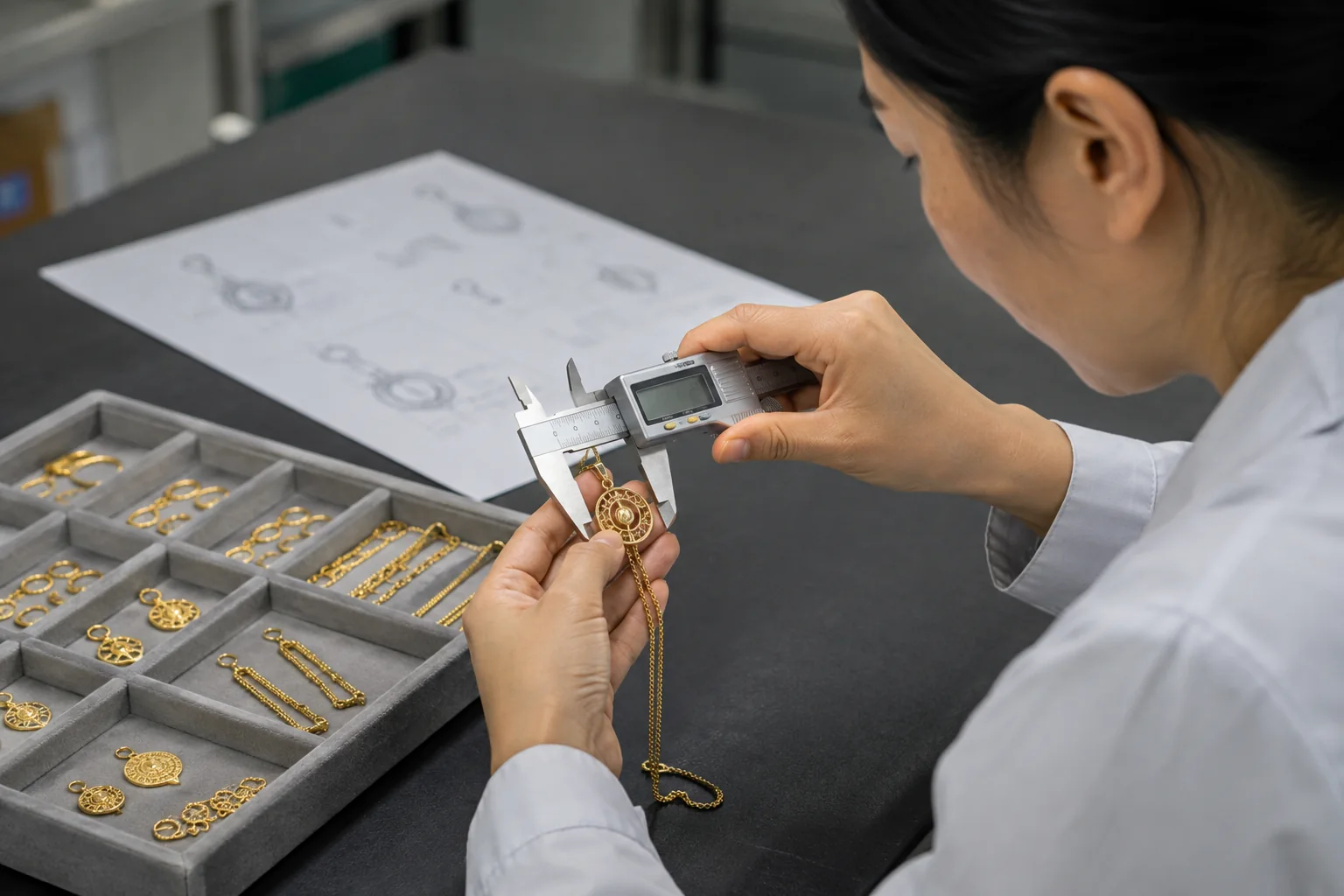
A site visit or remote review should follow the product path. Ask to see a representative job record from brief to finished pack rather than only a clean display area. Compare the artwork revision, sample reference, material instruction, finished unit, packaging, and records. A buyer does not need to demand confidential information outside the agreed relationship; the goal is to test whether the supplier’s stated controls can be demonstrated consistently.
| Review point | Practical evidence | Buyer question |
|---|---|---|
| Incoming components | Receiving record or controlled material identification | How is the correct component/finish directed to the correct SKU? |
| Sample release | Approved physical reference and dated specification | Which revision controls bulk release? |
| Assembly/finish | Work instruction and representative in-process checks | What is checked before packing? |
| Packaging | Product-in-pack reference, artwork, care insert | Does the pack match the exact item and market plan? |
| Dispatch | Packing list, carton logic, inspection record | Can the handover be reconciled with the PO? |
This method also improves installation preparation for the buyer’s own launch. The retailer, warehouse, quality, and marketing teams can receive the same approved product information, rather than recreating it from a supplier visit note.
Make corrective actions specific and time-bound
No site review is useful if every concern ends as “to be improved.” A corrective-action record should state the observed issue, evidence, owner, proposed action, target date, review method, and closure decision. Keep the language factual. For example: “Care-card revision did not match the approved artwork” is clearer than “documentation quality was weak.” The former lets the supplier identify a file-release control; the latter only creates debate.
For product issues, connect the action to a measurable production control: an updated product image, a revised packaging specification, a sample sign-off, a closure-function check, or a carton-count reconciliation. For social-compliance evidence, follow the buyer’s policy and the relevant program’s process; do not publish confidential results or claim remediation without appropriate evidence.
Customer requirements should be included only when they change the approved scope. A retailer needing an additional label, different pack configuration, or a document at shipment needs that requirement entered into the controlled product brief. Unrecorded requests are a major reason that a supplier appears to “miss” a requirement that was never released correctly.
Add the audit result to the order-release gates
Jewelry factory due diligence should not sit in a folder separate from the order. Link the relevant result to release gates:
- Onboarding gate: identity, production route, initial document review, and commercial contacts are complete.
- Sample gate: design brief, material/finish direction, product application, packaging, and sample acceptance criteria are agreed.
- Bulk gate: approved reference, PO, quantities, inspection points, destination requirements, and approved changes are aligned.
- Shipment gate: shipment inspection, SKU/count/pack checks, document handover, and discrepancy treatment are complete.
- Review gate: claims, returns, or quality feedback are logged and assessed before a reorder.
This sequence prevents one document from being used as a shortcut around product-specific work. It also lets a brand scale the depth of review as the relationship and order value grow.
FAQ
Does a BSCI document prove a jewelry product meets REACH or RoHS requirements?
No. Social-compliance evidence and product-related documentation address different questions. Review each document for its stated scope, sample/product, method, date, issuer, and conclusion, then obtain destination-market advice where needed.
What should a jewelry factory audit cover first?
Start with the actual supplier identity and product route, then review sample-release, quality, packaging, document-handover, and corrective-action controls. Match the depth to the planned order and the buyer’s risk policy.
Can a remote review replace a site visit?
It can support early due diligence when evidence is controlled and the buyer can follow a representative product record, but it may not answer every question a site visit or independent monitoring process would address. Decide based on the order, market, and policy requirements.
What should happen if an audit or document raises a concern?
Record the factual concern, the evidence, owner, action, due date, and verification method. Determine whether the concern affects onboarding, sample release, bulk production, or shipment, and follow the buyer’s policy before proceeding.
Conclusion
A jewelry supplier audit is most valuable when it is a disciplined buyer decision tool, not a badge. Confirm the site and production route, read every document for scope, inspect representative workflow evidence, turn gaps into controlled corrective actions, and connect the result to sample, bulk, and shipment gates. This approach gives private-label buyers a stronger basis for choosing, developing, and reviewing a supplier relationship.
CTA: prepare a due-diligence-ready jewelry brief
Share your product references, target markets, estimated quantity, supplier-verification requirements, and release plan. OWGOW can help organize the product and process details needed for sampling and controlled production. [Get a quote](../../index.html#contact) or email [info@owgow.com](mailto:info@owgow.com).
ARTICLE TAGS
RELATED RESOURCES
Keep building the brief
Use these buyer resources to connect this decision with the next specification, approval, or sourcing step.
- Private-label hub →
- How to Choose a Private Label Jewelry Manufacturer →
- Jewelry Supplier Scorecard: A Practical B2B Evaluation Framework →
External buyer reference: FTC Jewelry Guides